

Talking to Statues and Feeling the Blues: The Quarter’s Rich Street Performance Traditions
French Quarter Street Performers & Artists
Ask Maria Stankus what she does for a living and she’ll tell you she does nothing. In a sense that’s true, but she does nothing so well that people want to pose with her for photos and fill her tip jar with cash all day long.
Maria is a street performer in the French Quarter and, as a human statue, part of her job is to stand completely still. She can usually be found on the edge of Jackson Square with her skin covered in metallic gold paint, dressed in a matching antique wedding gown with an eight-foot train spread over the paving stones. Some visitors have dubbed her the Jilted Bride, and set against the backdrop of Spanish colonial architecture and the spires of St. Louis Cathedral she presents a visage that is ghostly and atmospheric.
She may be motionless, but she’s hardly doing nothing. Rather, Maria and those who ply similar trades in New Orleans are vital components of what makes the French Quarter such an intriguing and colorful place.
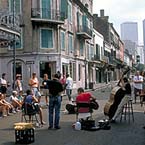
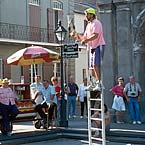
The French Quarter is the outdoor workplace for artists and musicians, tarot-card readers and fortune tellers, clowns and tap dancers and many others. Next door to the Café du Monde coffee stand, a high-energy troupe of tumblers works through a sidewalk floor show to a thumping hip hop soundtrack, while across the street a lone young man wanders the Square offering on-the-spot jokes for donations. Wander down Royal Street and you may find an escape artist wrapped in chains, a puppeteer, magicians in top hats and a lady of a certain age – known as Big Mama – who wears a church dress and veil and bangs out honky tonk numbers on an electric keyboard.
Lose Your Blues
“People come up and say ‘we moved down here because of y’all’,” says the Royal Street blues musician known almost universally as Grandpa.
Repeat visitors certainly have no trouble recognizing the 60-year-old harmonica slinger, with his bushy, snow-white beard, trademark overalls and tenaciously defended spot at the intersection of Royal and Toulouse streets. Blind in one eye, he wears silver-framed glasses with no lenses on which he has secured a small round mirror in front of his good eye. “It helps you see who’s talking about you behind your back,” Grandpa says.
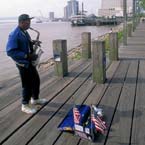
People come to New Orleans for music and culture, he says, and street performers are right there to provide it amid the shops, restaurants and other attractions of the Quarter.
“A lot of people have the blues, even if they don’t know it,” Grandpa explains. “People go on vacation because they have the blues. They’re tired of their boss, they’re tired of the same four walls. When you need to get away from something, that means you have the blues. People come by and hear us and they can relate.”
Spontaneous Manifestation of New Orleans Culture
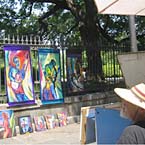
The street performance scene is perhaps most highly concentrated at Jackson Square, which is home to its own vibrant and newly resurgent artist colony. Art in the Square has been a part of the French Quarter since Civil War days when war widows are said to have sold paintings here to support their families. Today, it is the outdoor marketplace for an array of artists with a wide range of styles and backgrounds.
There’s William Warren, for instance, who taught both high school and college art courses in Providence, R.I., before moving to New Orleans. He now displays his vividly colored, almost fluid contemporary artwork on the wrought iron fence surrounding Jackson Square in the shade of oak boughs. While many performers follow the seasons and travel to other tourist destinations during the very hot New Orleans summers, William says most of his fellow artists in the Square work and live in the city year-round. William himself runs his own gallery, called the Waiting Room, along with his partner Pati D’Amico in the nearby Bywater neighborhood.
Every Day You Wake Up Is a Vacation
Many visitors are drawn to Jackson Square by the sounds of traditional jazz provided daily by a “house band,” alternately called the Jackson Square Band or the Jackson Square All-Stars. This varying amalgamation of anywhere from nine to 14 musicians may appear ad hoc, but there is a structure and professionalism among the players that ensures entertainment for visitors in the square nearly everyday.
“I play every day, all year-round. Vacations? Every day you wake up is a vacation,” says Andy Kauffman, who has played the stand-up bass for the band since 1997. A native of Pennsylvania, Andy wears a distinctive turban fashioned from a T-shirt to shelter himself from the sun. His instrument, too, is wrapped in fabric to protect it from long hours of exposure in the square.
“I don’t ever expect to retire,” he says. “I don’t ever expect to not be playing the bass. Even if I win the lottery, I’ll be living better, but I’ll still get up the next day and play here because that’s what I do.”
Unlike the wandering entertainers provided at resorts and theme parks, the musicians and performers in the French Quarter are a spontaneous manifestation of New Orleans culture, and they rely on the generosity of their sidewalk audiences to make a living.
The bluesy-country duo David Leonard and Roselyn Lionhart – a husband-and-wife team better known as just David and Roselyn – have been at it in the streets of the Quarter since 1975, through a career that has spawned six albums and frequent tours to the West Coast and overseas. The couple has four grown children who they have put through school by performing in the French Quarter, including the singer Arlee Leonard, who is also a teacher and writer in New York. She says her parents’ Royal Street workplace has provided her with a unique way to keep in touch between visits home.
“I always tell my friends, when you go to New Orleans walk down Royal and say hi to my mom and dad for me,” says Arlee.
Ian McNulty is a freelance food writer and columnist, a frequent commentator on the New Orleans entertainment talk show “Steppin’ Out” and editor of the guidebook “Hungry? Thirsty? New Orleans.”