


Sightseeing in the ‘Old Square’
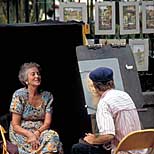
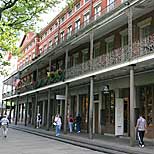
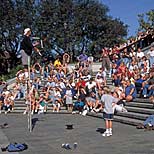
Artists, architecture & entertainers near Jackson Square
Before 1788, the French Quarter encompassed the entirety of New Orleans. Today the “old square “ (Vieux Carre), a six by twelve block parcel of land set on the inside of a bend in the Mississippi River, remains New Orleans’ most definitive area. While the city’s European heritage is readily discernible through its architecture, cuisine, social structure and the mannerisms of its people this holds true in the French Quarter more so than any other of the city’s neighborhoods. This small geographic space is personified by the diversity of interests and cultures represented here – now and historically. The French, Spanish, Anglo-Saxons, Italians, Germans, Irish, Africans, gay, straight, asexual, intellectuals, idiots, vagabonds, spinsters, debutantes, civilized, ribald, wealthy and penniless – they all have their marks on this place. A common trait shared by those who feel at home in this place is a longing to be free of the bonds of more ordinary, conservative societies. That yearning is the only cost of admission into what remains the most interesting of the world’s clubs.
The ideal time to visit the French Quarter is spring (early March – mid-May) when flowers, including brilliant multi-hued azaleas and fragrant wisteria, are in bloom. Days are generally warm, averaging 77F, and nights are cool, averaging 61F. The skies fairly sparkle and humidity is low. Festivals are numerous and include the Tennessee Williams Literary Festival and the French Quarter Festival.
Mid-October through mid-November are also highly desirable with highs of 72F and lows of 55F.
A car is unnecessary for exploring the French Quarter. The space is relatively compact and parking is a nuisance. Invest in a comfortable pair of shoes and wear lightweight clothing. Move at a leisurely pace. There is plenty to do and see and no reason to do it all in one day – if you can in any way avoid it.
People who live in the French Quarter – locals refer to them as “Quarterites”- are often content to sit upon their front “stoops” (steps) or balconies and simply watch the cast of characters go by or observe the play of dappled light and shadow upon the aged structures around them. These quiet activities are not to be overlooked by the visitor. Jackson Square, the benches outside of St. Louis Cathedral, Woldenburg Park and the Moonwalk are among the many public places where visitors can partake in simple, fulfilling observation. On weekends and most other days when fine weather prevails, the Square is a particularly popular spot for romantic couples and young parents and their children. Casual performance artists ply their crafts around the edges of the square. Mime artists, psychics, musicians, break dancers, jugglers, unicyclists, tap dancers and portrait artists can provide hours of fascinating entertainment.
Architectural styles within the French Quarter contribute greatly to the pleasures of simple observation. They are distinctive in that they are not wholly French or Spanish but an amalgamation of the two. Building types known as “Creole cottages,” “Creole townhouses,” and “shotguns” dominate the landscape. Many are embellished with trim and brackets from any number of styles popular during the Victorian era. As in old Europe, private residences are often housed directly above commercial spaces. The French Quarter’s famous, colorful “hanging gardens” can be seen flowing down from the lofty iron-laced balconies above the sidewalks. A leisurely stroll will reveal narrow, gated passages between buildings that lead to private tropical courtyards at the rear of many buildings.
As a general rule most of the French Quarter sights visitors will recognize from picture books are located “above” St. Peter street (The Upper French Quarter). The buildings are often three or four stories high and adorned with wrought iron. Popular bars, clubs and restaurants are located here, as are a number of historic homes, museums and the elegant antiques shops, boutiques and galleries of Royal and Chartres streets. Music pours fourth from doorways at all hours and a party can be unearthed with minimal effort.
Conversely, the area located “below” St. Ann street (The Lower French Quarter) offers a greater feel for what it is like to really live in the French Quarter. The buildings here are generally smaller and less ornate. Private homes and gardens are numerous. They share the blocks with eclectic shops, bars, and restaurants, which serve the neighborhood residents while also welcoming visitors in to experience this very enchanted little universe.
Jyl Benson is a New Orleans-based writer and publicist and frequent contributor to Time, New Orleans, St. Charles Avenue and the Times Picayune. She also regularly contributes to travel and guide books on New Orleans and the Gulf Coast.