

Some Liked It Hot: Open-Hearth Cooking In Emerante Hermann’s 1830s Kitchen
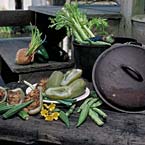
Come see the open-hearth cooking demonstrations at the Hermann-Grima House
Nineteenth century foodways are on the menu Thursdays in season at the open-hearth kitchen of the historic Hermann-Grima House on St. Louis Street. Where Samuel and Emerante Hermann’s enslaved cooks Charlotte and Sarah once dished up Creole cooking in the 1830s and ’40s, trained volunteers now fire the coals under swinging cranes suspending smoked hams and spiced sausage. Carefully, they recreate the cooking procedures of the open hearth, the “beehive” baking oven, and the “potager” or “stew holes,” a brick-surfaced cavity capable of simmering gumbos, stews, and red beans. On the large rotisserie of the open hearth, volunteers roast ducks, chickens, geese and beef, or place meats in a “tin kitchen,” an up-to-date gadget of the 1830s. The curved tin contraption made roasting easier for early cooks by reflecting heat from the fire and catching juices. One could also comfortably baste meats through a door in the rear. Right in the fireplace, one could also cook “down hearth” on a short-legged grill, or bake soda-leavened cornbread in a lard-greased Dutch oven.
The cooks bake bread loaves—whether French, round or brioche—in the great walled oven. An experienced cook can use the arm to test when the oven heat is ready, counting seconds at the rate of “one potato, two potato.” At a tolerance of “ten potatoes,” the oven is ready for the loaves to be baked right on the floor inside (presuming the arm has been extracted). The simple dough of flour, yeast and water, with a small pinch of salt or sugar and a dash of milk, is inserted on a paddle. The cook may also swab out the oven with a water-dipped cloth, depositing the moisture needed to crust up the French bread.
What’s good at the Market? Beef for sale, 3¢ a pound
Servants of Creole families shopped for meats, vegetables, and fruit each morning at the old French Market. Until early in the twentieth century, the highly regulated public market was the only location in the Quarter where butchers and vendors could legally sell meats and other perishables. Sunday morning market days were busiest and most appealing for socializing, as shoppers purchased items for the sumptuous noon meal. More than beef, veal, lamb or pork, mutton was a highly prized item. Early in the 19th century, beef was poor, but cheap, at 2-3¢ a pound. One could purchase a pair of hens, chickens, capons, geese or ducks for 60¢ to $1.40. Two large turkeys cost $4.00, and eggs were about 20¢ a dozen. Market hunters supplied deer, snipe, partridge, mallard, teal, quail, rabbits, hare and the tasty red squirrel that feasted on live oak acorns.
“First class” fish from Lake Pontchartrain—including trout, eel, redfish, and perch, cost 6 to 9¢ a pound. Fishermen sold the more common river fish, probably cats and Tchoupic or mudfish, directly from their boats at a cheaper price. Other seafood in the market included oysters at 50¢ per hundred, crawfish at 11¢ for 20, and shrimp at 11¢ for 30. As early as 1800, the shopper could choose kale, green beans, tomatoes, leeks, Havana bananas, apples, peaches, plums, figs, and pomegranates at 11¢ to 20¢ a bunch.
A great pastime of shopping was drinking chicory café au lait at marble-countered market stalls. Chicory is the roasted and ground root of chicoroium endiva, which probably came into use in New Orleans about 1820, soon after the French began to grow it in Paris market gardens. Englishman Charles Lyell’s writings about the French Market in 1856 still ring true: “There were stalls where hot coffee was selling in white china cups,” he wrote, “reminding us of Paris.” New Orleans people still drip their coffee slowly in French biggins, and flavor it with chicory. Don’t go home without it.
Open Hearth Cooking Demonstrations are part of the guided tours offered Thursdays at the Hermann-Grima House, 820 St. Louis Street. 504-525-5661.
Sally Reeves is a noted writer and historian who co-authored the award winning series New Orleans Architecture. She also has written Jacques-Felix Lelièvre’s New Louisiana Gardener and Grand Isle of the Gulf – An Early History. She is currently working on a social and architectural history of New Orleans public markets and on a book on the contributions of free persons of color to vernacular architecture in antebellum New Orleans.