


Micaela Almonester Pontalba: The Baroness of Extremes
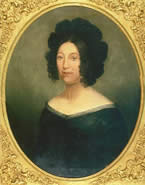
Baroness Micaela Almonester Pontalba. Photo courtesy of the Louisiana State Museum.
Micaela Almonester Pontalba was the wealthiest woman in New Orleans, but her biographer called her a frump for her lamentable everyday wardrobe. Like most Creoles, she married a cousin, but her in-laws turned out to be more interested in her money than in family love and loyalty.
She grew up in New Orleans where she completed her greatest work, but spent most of her adult life in Paris. She is known to history as the “Baroness Pontalba,” a title inherited by a lackluster husband as she was about to divorce him.
Contemporaries called her persistent, bright-eyed, intelligent, vivacious, prompt, shrewd, and business-like. Male historians characterized the Baroness as strong-willed, imperious, penurious, self-indulgent, and vacillating, while her female biographer uncovered a life of affliction and resilience. Her portrait as a young wife shows a woman of grace and reflection; her photograph at an older age shows a hardened veteran with unmistakably masculine features.
Married to Misery
No contradiction was greater than the chasm between Micaela’s privileged life and her sufferings at the hand of her husband’s family. Born in 1795, she was married to her cousin Xavier Celestin de Pontalba at the age of 15. Her father, Andres Almonester y Rojas, had been a wealthy New Orleans notary and politician who amassed a fortune in colonial real estate with the indulgence of Spanish authorities.
In 1777, the crown allowed him to acquire public land on both sides of the town square, which he developed into a lucrative rental property and the base of a fortune. Micaela’s father-in-law was Baron Joseph Delfau de Pontalba, who served the French and Spanish as a military officer and lived in a state of paranoia about money and social control.
Almonester was 70 years old when Micaela was born, and died just three years later. In a marriage contract of 1811, her widowed mother agreed to an expensive dowry for her daughter to seal the alliance with their socially prominent Pontalba cousins. After her wedding, Micaela was promptly whisked from New Orleans to Mont l’Eveque, the Pontalba family chateau near Paris.
Micaela bore her husband five children, but the influence of his father on their marriage was disastrous. It soon became apparent that the elder de Pontalba was intent on seizing the Almonester fortune. Two years after the wedding, he had her sign a general power of attorney to her husband giving him control of her assets, rents, and capital, both dotal and as heir of her father.
French law provided a “head and master” marital regime, but husbands had grave obligations to account for their wives’ funds, mortgaging their own assets as a guarantee. Micaela began to suspect their intentions when she discovered that the elder Pontalba had no intention of fulfilling his side of the marriage contract and was appropriating her money.
No Way Out?
By the 1830s, Micaela was a virtual prisoner of the Pontalba family, who made her life miserable. If she visited New Orleans, she was accused of deserting her husband. In Paris, she began a series of lawsuits to get a separation but consistently lost to the strictures of the French law on marriage. Her efforts to protect her fortune enraged her father-in-law, who in November 1834 shot her point blank with a pair of dueling pistols at the family chateau. That evening, after brooding through the day, he took his own life with the same pistols.
With four round gunshots to the chest, fingers shattered, and blood pouring, Micaela survived. Several lawsuits later, she received her separation. In New Orleans, a civil law judge ordered the restitution of her property. She lived to build the elegant rowhouses known to history as the Pontalba Buildings, on Jackson Square, and a vast Parisian hotel, now used as the American Embassy. She died in 1874 at the age of 78.
Micaela’s life has been the subject of two books and an opera. Intimate Enemies, a riveting 1997 biography by Christina Vella, reads like a novel. Dense and vibrantly written, it portrays its subject sympathetically. Baroness Pontalba’s Buildings, an earlier and shorter work by the late architect Samuel Wilson, Jr. and historian Leonard Huber, shows respect for her accomplishments in building the Pontalba Buildings but lacks the pathos of the full story. Thea Musgrave’s opera Pontalba was commissioned as a fitting France-Louisiana subject to commemorate the Louisiana Purchase Bicentennial of 2003.
In the end, French law notwithstanding, the Baroness got her money back.
Sally Reeves is a noted writer, historian, translator, and archivist. She is known for her work in the New Orleans Notarial Archives as “Louisiana’s premier archivist” and her publications on New Orleans history.