French Quarter Frequently Asked Questions

1. What
does “Vieux Carre” mean?
2. Is the French Quarter
really French?
3. How big is the French Quarter?
4. Can I drive in the French
Quarter?
5. Can I park in the French
Quarter?
6. Is it safe in the French
Quarter?
7. Is it always
like Mardi Gras in the French Quarter?
8. What are the drinking
laws in the French Quarter?
9. Can I drink on
the streets of the French Quarter?
10. Isn’t the
French Quarter dirty?
11. What’s that smell?
12. Will I get blown
away by a hurricane (the storm)?
13. Will I get blown
away by a Hurricane (the drink)?
14. Is there only Jazz in New
Orleans?
15. Is all of the food
spicy?
16. When is the best
time of the year to visit?
17. Where are the cemeteries
and how can I tour them?
18. Where can I get some
aspirin/bottled water/groceries?
19. Should I stay
in the French Quarter or the Garden District?
20. What’s the weather
like?

1.
What does “Vieux Carre” mean?
On the way into New Orleans on Interstate 10, don’t bother
looking for the “French Quarter” exit. Exit 235 directs
travelers to the “Vieux Carre” (say: Voo Car-Ay),
which literally translated means “Old Square” in
French and for all practical purposes means French Quarter.
Return to Top
2.
Is the French Quarter really French?
The French Quarter is a melting pot of French, Spanish, Cajun
and Creole influences that all add up to a very American neighborhood.
Born as a French territory in 1718 and raised by the Spanish
until the Louisiana Purchase in 1803, the French Quarter today
reflects and embraces the diversity of the U.S.A.
Return to Top
3.
How big is the French Quarter?
The French Quarter is a 78 square-block area, 13 blocks long
and 6 blocks deep. Bordered by Esplanade Avenue, Canal Street,
North Rampart and the Mississippi River, the Quarter is an entire
neighborhood in the city of New Orleans, not just a “strip” lasting
a couple of blocks.
Return to Top
4.
Can I drive in the French Quarter?
French Quarter streets are all very narrow, single lane, one-way
streets. Vehicles are allowed in, but be advised that street
closings are common and so is gridlock. Bourbon Street is blocked
to traffic every night, as is Royal Street every day to give
pedestrian revelers and shoppers more room to wander. Some trucks,
buses and motor homes may not be able to clear the tight corners,
so check ahead for specific details if arriving in a larger vehicle.
Return to Top
5.
Can I park in the French Quarter?
Parking in the French Quarter is often hard to find and always
expensive. If the hotel offers parking, take it. Public lots
are just as expensive and not as secure. Street parking is a
gamble, and many a vacation has been ruined by costly parking
tickets and towing. Meter Maids are everywhere and take their
jobs very seriously. ALWAYS look for signs before parking on
a French Quarter street, and if possible just leave the car at
home.
Return to Top
6.
Is it safe in the French Quarter?
The French Quarter is the crown jewel of New Orleans, and as
such is heavily patrolled and protected 24 hours a day by the
New Orleans Police Department. While crime is very low in the
neighborhood, common sense is a necessity when traveling in any
large and unfamiliar city. Be sure to carry a map of the area
to avoid wandering off of the beaten path, and use extra care
at night to stay where people are. If a block seems a little
too quiet, turn back onto one of the main streets of Bourbon,
Royal, Chartres or Decatur.
Return to Top
7.
Is it always like Mardi Gras in the French Quarter?
A little bit of Mardi Gras lasts all year long on Bourbon Street.
Beads, boas and general revelry are condoned and even encouraged.
Contrary to popular belief, public nudity is not legal anywhere
in New Orleans, but that doesn’t stop some of the more
intoxicated visitors. For a more genteel, civilized French Quarter
experience, simply stay off of Bourbon Street. There are another
20 historic, charming and fun streets to explore, after all!
Return to Top
8.
What are the drinking laws in the French Quarter?
The city of New Orleans is not required to close its bars at
any particular time. This means that a bar may stay open around-the-clock,
24 hours a day, and many in the French Quarter do just that.
Not all bars serve all night, many close at 2 a.m., 4 a.m. or
6 a.m., or simply whenever the last customer finally staggers
home. Most bars enforce an “18 to enter, 21 to drink” law
at the door, although many choose to require all patrons to be
21 to enter. Each particular establishment reserves the right
to close whenever they choose, and refuse service to those underage
or already intoxicated.
Return to Top
9.
Can I drink on the streets of the French Quarter?
As native New Orleanians know, asking for a “go-cup” anywhere
else in the country simply produces blank stares. In the French
Quarter, getting a go-cup and transferring your drink from glass
to plastic to take it outside on the way to the next bar is a
ritual and a tradition. Alcohol may be consumed outside of a
bar as long as it is in an unbreakable container, but beware
- public drunkenness is an easy way to go to jail in New Orleans,
so always use moderation!
Return to Top
10.
Isn’t the French Quarter dirty?
Thousands of visitors eating, drinking and being merry on the
streets of the French Quarter all day, every day, creates a lot
of garbage, and early morning on Bourbon Street after a typical
wild night smells pretty bad. Luckily, the Mayor’s Clean
Team picks up the trash every single day, and power washers and
street cleaners scrub the streets down weekly. Help make the
job easier by using the many garbage cans throughout the Quarter.
Return to Top
11.
What’s that smell?
The French Quarter appeals to all of the senses, including the
sense of smell. The aroma of a hundred restaurants’ kitchens
mingles with the scent of flowers on the breeze to create an
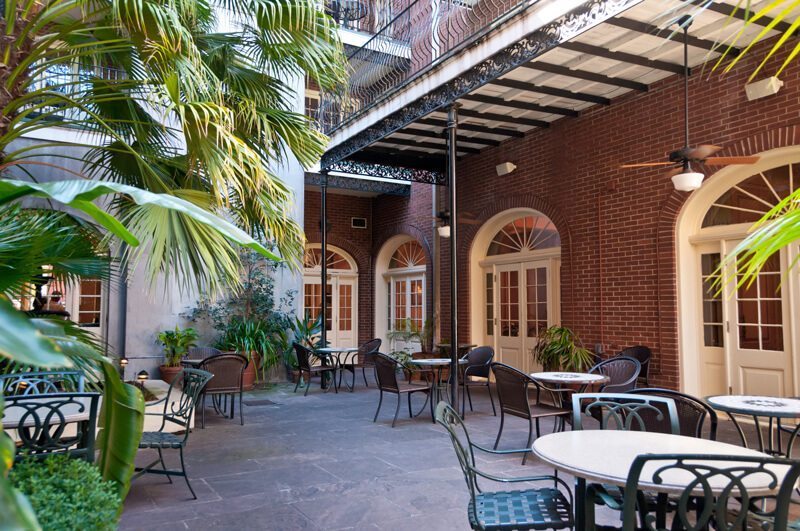
intoxicating perfume. Night Blooming Jasmine wafts from secret
courtyards, and Sweet Olive blossoms delicately infuse the air
with romantic southern charm.
Return to Top
12.
Will I get blown away by a hurricane (the storm)?
Hurricane season on the Gulf Coast runs from June to October.
A true hurricane brings torrential rains and winds upwards of
74 mph, but New Orleans itself has only been affected by tropical
depressions and storms in recent years. During its long history,
the Quarter has survived hurricanes that have leveled other parts
of the city due to being built on a high ridge along the Mississippi
River. With the protective shutters on the windows and solid
construction of the older buildings, the French Quarter is actually
the safest place in the city to be during a severe storm.
Return to Top
13.
Will I get blown away by a Hurricane (the drink)?
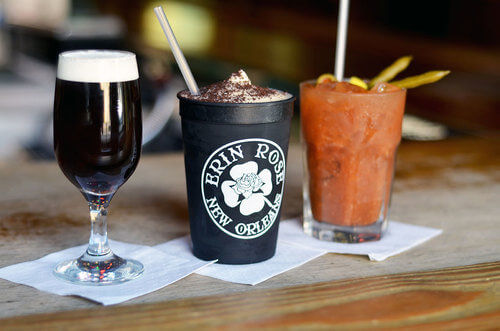
Pat O’Brien’s serves more alcohol than any other
bar in the world. Most of it goes into the infamous “Hurricane” a
deceptively tasty yet deadly concoction made up of rum, more
rum, yet more rum and other secret ingredients. Served in a gigantic
26 fluid ounce glass, over-consumption of Hurricanes can lead
to fun, embarrassment, and jail, in that order, so use moderation!
Return to Top
14.
Is there only Jazz in New Orleans?
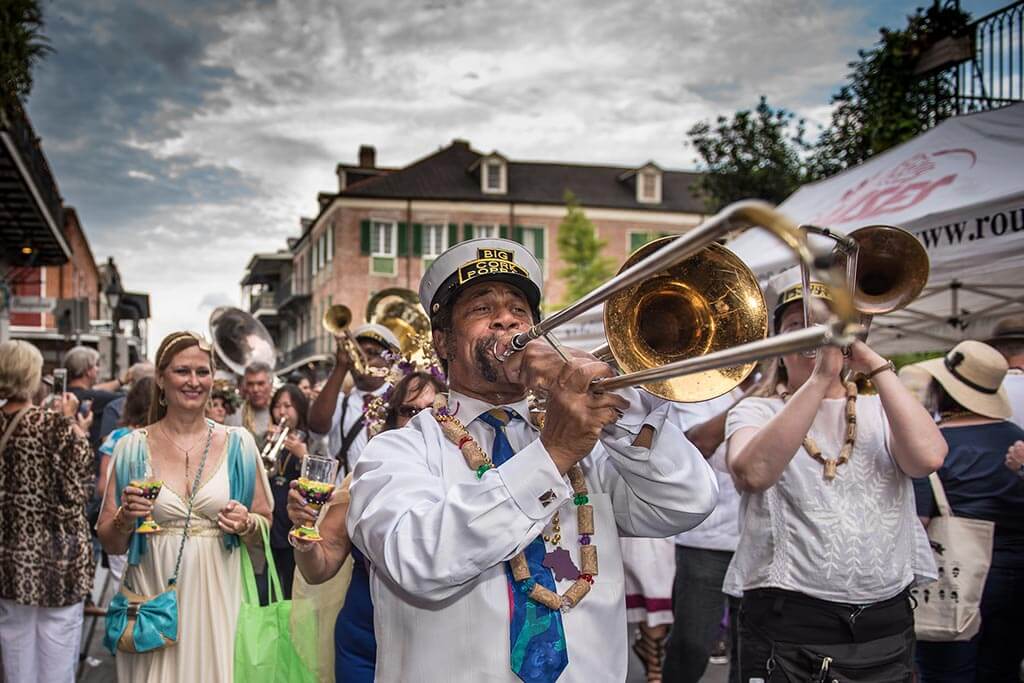
No. The French Quarter and the adjacent Faubourg Marigny are
home to over 100 live music clubs playing all varieties of blues,
pop, rock, zydeco, folk and funk. Every night of the week both
local and national acts entertain both locals and visitors.
Return to Top
15.
Is all of the food spicy?
New Orleans is known for Cajun food, and Cajun food is known
for its generous use of cayenne pepper. However, many restaurants
will modify the amount of heat in their dishes according to the
diner’s palate. And with over 200 restaurants in these
78 square-blocks, there truly is something for everyone, from
burgers to bagels and from seafood and steaks.
Return to Top
16.
When is the best time of the year to visit?
July and August offer the best deals on hotels and fewer visitors
than the spring or fall, but the heat index soars. December and
January also offer reasonable deals along with milder temperatures.
The busiest times to visit (other than Mardi Gras, of course)
are March and October when the weather is gorgeous and city wide
conventions are most commonly booked. Hotel rooms can be hard
to find and expensive.
Return to Top
17.
Where are the cemeteries and how can I tour them?
The above ground cemeteries of New Orleans are fascinating and
eerily beautiful. Just steps from the French Quarter sits St.
Louis Cemetery #1, where voodoo queen Marie Laveau rests alongside
early founders of the city. Located on the edge of an unsavory
neighborhood, it is not recommended to visit outside of a guided
tour, many of which are available daily through any hotel front
desk.
Return to Top
18.
Where can I get some aspirin/bottled water/groceries?
The French Quarter is an actual neighborhood that over 4,000
residents call home. As such, there are many little convenience
stores and a couple of larger ones that supply life’s necessities.
A & P, Walgreens and Circle K are the more familiar names,
but prices are sometimes better at the smaller “mom and
pop” stores, so be sure to give them a try first.
Return to Top
19.
Should I stay in the French Quarter or the Garden District?
The Garden District of New Orleans is celebrated for its stately
homes and lush greenery. When staying in the French Quarter,
the St. Charles Streetcar is easily accessible for the scenic
trip up the Avenue, and many other attractions such as the French
Market, Bourbon Street, Harrah’s Casino and the Aquarium
of the Americas are within easy walking distance. The Garden
District area is mostly residential, and while we at FrenchQuarter.com
are no doubt biased, we believe that the Quarter just has more
to offer and is a more convenient place to stay while visiting
New Orleans.
Return to Top
20.
What’s the weather like?
Generally speaking, the winter months are mild with highs in
the 60’s and lows usually in the 40’s. Spring and
fall have near perfect weather, with sunny skies and temperatures
in the 70’s and 80’s. The sticky summer months feature
high humidity, daily rain showers and highs hovering in the 90’s.
Summer nights however are often pleasant, with lows around 70
degrees and clear skies. Pack a variety of clothing no matter
what time of the year to prepare for the often unpredictable
weather. It is not unusual to hit 85 degrees in December, 50
degrees in May or 20 degrees in January.
Return to Top